
Technical
7 tips for preventing fuel system failures
As one of the UK’s leading restorers of luxury classic cars, we come across all sorts of common problems that require the attention of our specialist engineers.
At KWE our aim has always been to ensure our customers receive a ‘better than new’ restoration service for their Jaguar XJS, XJ, XK and Aston Martin DB7 vehicles. So, we believe it’s important to share information that will ensure these vehicles maintain their reliability and roadworthiness.
We’ve noticed an increase in the number of classic cars being delivered to us for restoration with fuel system failures. Here we offer 7 preventative tips that will keep your vehicle in good condition and help avoid expensive remedial repairs.
Rust and sludge
The primary problem is due to the accumulation of rust and sludge in the fuel tank.
Even though high quality fuel filters are used in the fuel system, fuel pump damage and clogging of the injectors can occur.
An internally seized fuel pump caused by rust and sludge
Rust forms when moisture and air come into contact with unprotected steel. To prevent your fuel system from being attacked by rust it’s important to eliminate at least one of these materials.
The inside of a fuel tank showing heavy contamination with rust and sludge
- Keep the fuel tank topped right up so that air (oxygen) is largely excluded, unless the car is used at least weekly
- Try to avoid high ethanol petrol since it absorbs water from the atmosphere. You can ask the fuel company or forecourt manager about the ethanol percentage of the fuel it uses. Ideally, you should try and avoid fuels with ethanol content greater than 5%. On the continent, especially France, high ethanol percentages are common. If you drive overseas, try to burn off all the fuel that was purchased while abroad and then replenish with British fuel. Fuel with high ethanol content will affect the performance of your classic car and lead to the corrosion and deterioration of the fuel system and other engine parts.
A container of fuel removed from a car that had inexplicably broken down in France. After a local garage had misdiagnosed the fault, the vehicle was sent to KWE for further investigation. Particles of dissolved rubber hose were found in the French fuel caused by the high ethanol content. This in turn led to clogging and the eventual seizure of the fuel pump
3. Help protect the injectors by adding a petrol additive such as Forté Specialist Injector cleaner. For long term use Forté Advanced Gas Treatment (search eBay)
4. Avoid filling up at a petrol station if a forecourt tanker has recently visited to refill the underground storage tanks as this process can stir up the water in them which then ends up in your own vehicle’s tank
5. Have your tank and swirl tank emptied and cleaned out at least every ten years. Ideally have the tank treated internally so that the normally bare steel is coated
6. If your vehicle isn’t driven regularly then run your engine once a week for at least 15 minutes to keep the injectors working properly. Ideally, drive the car for a few miles to keep the brakes working and tyres exercised, while avoiding wet or salty conditions
7. The slow evaporation of the volatile elements of fuel results in a sticky and non-combustible residue. This can clog fuel injectors and prevent the car from starting and running smoothly. It’s therefore important to drain and replenish with fresh fuel if the vehicle is left for any length of time
Additional tips for preventing classic car rust can be found here. Happy motoring!
Boiling Brake Fluid
It is not uncommon to experience total brake failure after a long, hard period of braking – just when you want full brake power. By far the most likely cause is that the high heat generated in the brake callipers has raised the brake fluid above the boiling point of water, i.e. 100°C. Normally, this would not be a problem – brake fluid is designed to withstand at least 200°C – but if the fluid contains water above approximately 3%, then this rise in temperature will cause the water in the brake fluid to boil and turn into a vapour. The vapour is easily compressed, so the pressure of the brake pedal merely compresses the water vapour and the brake fluid does not move to operate the brake callipers. Result – pedal to the floor.
Once the fluid has cooled to below 100°C, the water vapour condenses back into water. Water is not compressible, so the brakes feel normal again. Normal brake fluid (not Silicone types/DOT5) absorbs water relatively quickly, and can easily get to 3% after a few years.
High water content in the brake fluid also encourages rusting at the calliper pistons. This rusting can, and does, cause seizure of some or all of the pistons. This in turn causes wild brake pulling to left or right, and overheating of one or more brake discs. This leads to overheating of the brake fluid, resulting in the problem outlined above.
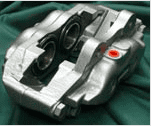
While changing the brake fluid should be a routine maintenance or service action, it is seldom carried out – especially with classic cars which may not be used for years at a time. Changing the brake fluid regularly, however, has the benefit of keeping the water content low enough to avoid brake failure and rusting. So be warned – change the fluid every 2 years to avoid potentially lethal brake failure.
Avoid a nasty surprise by keeping on top of your classic car’s maintenance. Contact KWE to schedule your next service appointment.